






Detect baseline risk factors
Measure room ins and outs, sterile-field activity, case duration, and workflow variation across procedures, rooms, and teams.
nSight helps hospitals reduce avoidable risk by measuring the behaviors, workflows, and safety signals that shape surgical outcomes.
Every OR already generates data that can help improve safety: room movement, sterile-field activity, procedure duration, checklist execution, count workflows, and postoperative outcomes. nSight helps hospitals capture, structure, and act on that data so teams can strengthen protocols, identify risk patterns, and improve patient safety.
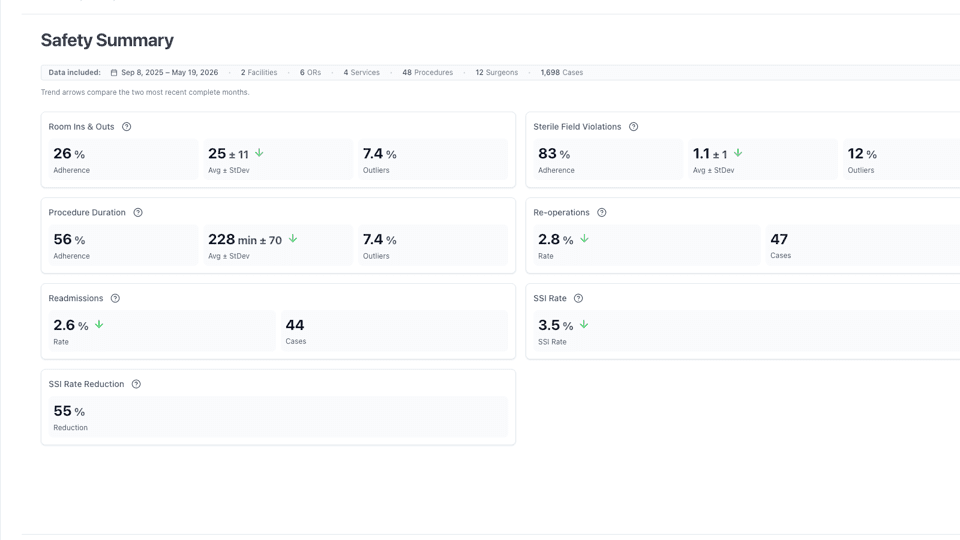
nSight helps hospitals identify safety patterns across rooms, procedures, teams, and outcomes.
Track room entries, exits, and traffic patterns that may affect infection risk, workflow discipline, and case disruption.
Detect sterile-field activity and potential boundary events to support review, coaching, and process improvement.
Analyze case length alongside safety signals, workflow variation, infection risk, and postoperative outcomes.
Support checklist completion through the digital whiteboard, with structured logs of checklist steps, timing, and completion patterns.
Support surgical count workflows through the digital whiteboard, helping teams create a clearer record of count-related steps and retained-item risk controls.
Analyze safety signals alongside SSIs, readmissions, reoperations, retained-item events, and other customer-defined outcomes.
nSight helps hospitals move beyond isolated safety observations by linking workflow signals, safety practices, and downstream outcomes over time.
Room traffic, sterile-field activity, procedure length, team composition, service line, surgeon, room-level patterns, checklist completion, and count workflows can all shape surgical risk. nSight brings these signals together so hospitals can identify where safety practices vary, where risk patterns emerge, and where targeted improvement may reduce SSIs, readmissions, reoperations, retained-item risk, and other avoidable safety events.
Measure room ins and outs, sterile-field activity, case duration, and workflow variation across procedures, rooms, and teams.
Compare safety signals against SSIs, readmissions, reoperations, retained-item events, and other customer-defined outcomes.
Identify where protocols, training, staffing, room practices, or workflow standardization may reduce avoidable risk.
nSight helps teams move from retrospective review to continuous safety improvement.
The platform helps safety and perioperative leaders investigate risk patterns, compare performance across rooms and services, review outliers, and trigger configurable notifications or workflows when action is needed. AI-assisted analysis helps teams understand where protocols are working, where workflows drift, and where targeted coaching or standardization can improve patient safety.
Identify room traffic, sterile-field, case duration, or workflow patterns that may contribute to SSI risk.
Use digital checklist and count-support workflows to reinforce required safety steps and create clearer completion records.
Find where safety behaviors vary by room, service line, procedure, surgeon, or team, and focus improvement efforts where they matter most.
We’ll show how nSight captures safety-critical OR activity, connects it to outcomes, and helps hospitals turn daily workflows into measurable patient-safety improvement.